

 I am Aasheesh, founder, mentor, and product leader helping early-stage marketing teams execute smarter Go To Market.
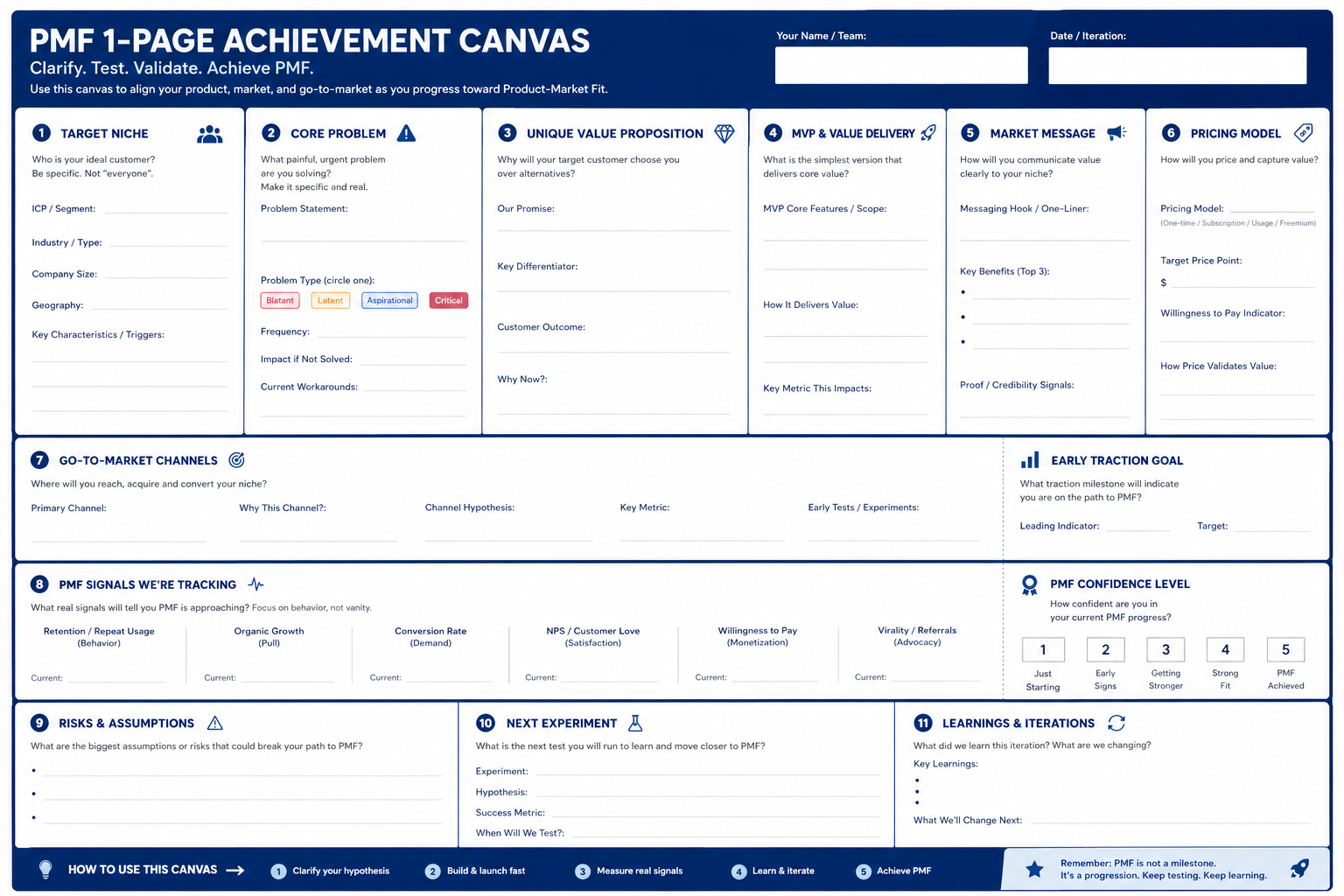
Before You Begin
The PMF Canvas is not a one-time exercise. It is a living document you return to every 2–4 weeks as you test assumptions and collect real signals from the market.
Fill it in this order:
- Sections 1–6: Fill these in one sitting. They represent your current best hypotheses.
- Section 7: Fill after you’ve identified your strongest distribution path.
- Sections 8–11: Fill after your first 2 weeks of real-world testing.
The goal of the canvas is not to be right the first time. It is to make your assumptions visible so you can test them, break them, and rebuild them on real evidence.
Your Two ICPs at a Glance
This guide uses two real personas throughout. Every worked example will reference one or both.
| ICP A – The Early Marketer | ICP B – The Solo Founder |
| Role Marketing executive or manager, <2 years experience | Solo founder, pre-revenue or early revenue |
| Situation Just stepped into a GTM role with no playbook to follow | Building alone, wearing every hat, no dedicated marketing |
| Pain Doesn’t know what to prioritise or how to measure success | Generating zero pipeline despite working 60-hour weeks |
| Trigger First 90 days in role, proving themselves to leadership | Just hit a wall, 6 months in, no product-market fit signal |
| Goal Build credibility fast, learn GTM frameworks, avoid mistakes | Find first 10 paying customers before runway runs out |
Target Niche: Who is your ideal customer? Be specific. Not “everyone”.
Why this section exists
Most early-stage companies fail at this section because they are afraid to narrow down. The instinct is to keep the ICP broad to avoid leaving money on the table. This instinct is wrong. The narrower your niche, the sharper your message, the faster your traction.
How to fill each field
- ICP / Segment: Write one sentence describing the specific type of person who has the most urgent version of the problem you solve. Not a category. A person in a situation.
- Industry / Type: The vertical your ICP works in. Be specific — “B2B SaaS” is better than “tech”. “D2C beauty brands on Shopify” is better than “ecommerce”.
- Company Size: Headcount or revenue range. This matters because it determines budget authority, decision-making speed, and tool sophistication.
- Geography: Where are they? If you are starting locally, say so. Geographic focus is not a limitation — it is a distribution advantage.
- Key Characteristics / Triggers: This is the most important field on this section. What specific event just happened in their life or business that makes them ready to buy right now? Not demographics. A moment.
| ICP A – Early Marketer ICP: A marketing manager at a 20–50 person B2B SaaS company, less than 18 months into their first dedicated marketing role, who has just been asked by their CEO to build a GTM plan from scratch and has no framework to start from. Trigger: Just received a Q2 pipeline target with no playbook to hit it. |
| ICP B – Solo Founder ICP: A solo B2B SaaS founder, pre-Series A, who has a working product but zero repeatable customer acquisition motion, currently generating fewer than 5 inbound leads per month. Trigger: Just crossed 6 months post-launch with no PMF signal and a runway of less than 9 months remaining. |
| ⚠ Watch out: Do not write a demographic. Write a moment. “Marketer at a startup” is a demographic. “Marketer who just got handed their first pipeline target with no GTM playbook” is a moment. |
Core Problem: What painful, urgent problem are you solving? Make it specific and real.
Why this section exists
The problem you think you are solving and the problem your customer actually experiences are rarely the same thing. This section forces you to close that gap. If you cannot describe the problem in your customer’s language, your messaging will miss.
Problem Type – pick one honestly
- Blatant: The customer knows they have the problem and is actively looking for a solution. Easiest to sell. Hardest to differentiate.
- Latent: The customer has the problem but does not yet recognise it as a problem. Requires education before selling. Longer sales cycle.
- Aspirational: The customer wants something better but is not in active pain. Motivation is desire, not urgency.
- Critical: The problem is causing immediate, quantifiable damage. Highest urgency. Shortest sales cycle.
How to fill each field
- Problem Statement: One sentence. The specific pain your ICP is experiencing right now. Use their language, not yours.
- Frequency: How often does this problem occur? Daily friction converts better than occasional inconvenience.
- Impact if Not Solved: What is the cost of inaction? Revenue lost, time wasted, reputation damaged, stress accumulated. Make it specific.
- Current Workarounds: What are they doing right now to solve this? This is critical — your real competition is not other products. It is the workaround.
| ICP A – Early Marketer Problem Statement: Early-career marketers are given pipeline targets and channel ownership with no structured GTM framework, forcing them to reverse-engineer strategy from tactics they find on LinkedIn and YouTube. Problem Type: Blatant. Frequency: Daily — every campaign decision, every channel question, every budget conversation. Impact if Not Solved: Missed pipeline targets, loss of credibility with leadership, likely to be managed out within 12 months. Workarounds: Random LinkedIn posts, copying competitor strategies, asking senior colleagues informally, consuming newsletters without a framework to apply them. |
| ICP B – Solo Founder Problem Statement: Solo founders have a product that works but no repeatable way to find the customers who need it, causing them to mistake activity for traction. Problem Type: Critical. Frequency: Daily — every morning they open their inbox to no replies. Impact if Not Solved: Runway expires before PMF is reached. Company dies. Workarounds: Posting on LinkedIn hoping for inbound, asking friends and family to share, cold emailing with no targeting, attending every possible networking event. |
| ⚠ Watch out: The most common mistake: writing the problem from your perspective, not your customer’s. “Lack of GTM visibility” is your language. “I have no idea if my marketing is actually working” is theirs. |
Unique Value Proposition: Why will your target customer choose you over alternatives?
Why this section exists
Your UVP is not your tagline. It is the honest, specific answer to the question every buyer is silently asking: why should I choose this over everything else, including doing nothing?
How to fill each field
- Our Promise: The single commitment you make to your customer. What is the specific outcome you guarantee or enable? One sentence. No jargon.
- Key Differentiator: The one thing about how you deliver that outcome that no competitor can honestly claim. It must be real. “Best in class” is not a differentiator. “The only tool built specifically for solo founders with no marketing team” is.
- Customer Outcome: Describe the specific before-and-after. What does your customer’s world look like after they use your product? Outcomes, not features.
- Why Now?: What has changed in the market, in technology, or in your customer’s world that makes this the right moment for your solution to exist?
| ICP A – Early Marketer Promise: We give early-career marketers a proven GTM framework they can apply on day one, without needing five years of experience to understand it. Differentiator: The only GTM education platform built around real ICP moments and validated frameworks, not generic tactics. Outcome: A marketer who arrives with no GTM playbook leaves with a structured 90-day plan, a channel hypothesis, and the language to defend it to their CEO. Why Now?: GTM complexity has increased dramatically while entry-level training has not kept pace. Most marketers are learning on the job with no structured framework. |
| ICP B – Solo Founder Promise: We help solo founders get their first 10 paying customers using a validated GTM framework, not guesswork. Differentiator: The only GTM resource that combines ICP validation, messaging frameworks, and channel experiments in a single system designed for founders without a team. Outcome: A founder who is generating zero qualified pipeline leaves with a documented ICP, a tested outreach sequence, and a channel that is producing replies. Why Now?: Founder-led sales is the highest leverage GTM motion but almost no structured resource exists to teach it. Most advice is written for companies that already have a sales team. |
| ⚠ Watch out: The Why Now field is the most skipped. It matters because it is the answer to “why not just wait.” If you cannot answer that, your urgency argument collapses. |
MVP & Value Delivery: What is the simplest version that delivers core value?
Why this section exists
Most early products try to do too much. This section forces you to identify the single core value your product delivers and strip everything else away. The MVP is not a lesser product. It is a focused one.
How to fill each field
- MVP Core Features / Scope: List only the features required to deliver the core promise. If you have more than three, you are probably over-scoping.
- How It Delivers Value: Describe the mechanism — the specific thing that happens that creates the result your customer cares about.
- Key Metric This Impacts: What single number in your customer’s business or life improves when they use your product? Revenue, time saved, leads generated, anxiety reduced. One metric.
| ICP A – Early Marketer MVP Features: GTM Validation Canvas, ICP Moment Worksheet, Channel Scorecard. How It Delivers Value: The frameworks give a marketer the exact questions to ask before spending any budget, preventing the three most common early GTM mistakes. Key Metric: Time to first channel experiment — reduced from 3 months to 2 weeks. |
| ICP B – Solo Founder MVP Features: ICP Moment Worksheet, Outbound Message Framework, 30-day Channel Experiment Template. How It Delivers Value: The system takes a founder from vague ICP to a tested outreach sequence in 72 hours, without needing to hire a GTM consultant. Key Metric: Number of qualified sales conversations booked in first 30 days. |
| ⚠ Watch out: The most common MVP mistake: shipping features your ICP didn’t ask for because they felt important to you. If your customer did not name it as a pain in a discovery call, it is probably not part of the MVP. |
Market Message: How will you communicate value clearly to your niche?
Why this section exists
Positioning lives in your strategy deck. Message lives in the words you actually use in subject lines, landing pages, LinkedIn posts, and sales calls. This section builds the bridge between the two.
How to fill each field
- Messaging Hook / One-Liner: The single sentence that makes your ICP say “that is exactly my problem.” It should feel uncomfortably specific. If it could describe any product, rewrite it.
- Key Benefits (Top 3): Not features. Benefits. The specific improvements to your customer’s situation. Write each one as: “You will [specific outcome] so that [specific consequence].”
- Proof / Credibility Signals: What evidence exists that your product works? Customer quotes, before/after results, credentials, case study numbers. Even early social proof counts — “50 founders tested this framework and booked calls within a week” is credible.
| ICP A – Early Marketer Hook: The GTM framework for marketers who have been handed a pipeline target and have no idea where to start. Benefits: You will know exactly which channel to test first so that you stop wasting budget on everything at once. You will be able to present your GTM strategy to your CEO with evidence, not opinions. You will avoid the three positioning mistakes that cost most marketers their first 90 days. Credibility: Built from 200+ founder and marketer interviews. Used by GTM leaders at early-stage B2B companies. |
| ICP B – Solo Founder Hook: From zero qualified leads to 10 paying customers — without hiring a sales team or running paid ads. Benefits: You will know who your real ICP is so that your outreach stops going to the wrong people. You will have a tested outbound sequence that gets replies so that you stop sending emails into silence. You will close your first 10 customers so that you have real evidence of PMF before your runway expires. Credibility: The same framework used to validate three GTM motions across B2B SaaS companies. Average time to first qualified conversation: 11 days. |
| ⚠ Watch out: Benefits are not features in disguise. “14 frameworks included” is a feature. “You’ll know exactly which channel to test first” is a benefit. If your benefit starts with “we” instead of “you,” it is probably still a feature. |
Pricing Model: How will you price and capture value?
Why this section exists
Pricing is a positioning signal before it is a revenue decision. The price you charge tells your customer how serious you are, who you are for, and how much you believe in the outcome you deliver. Getting this wrong does not just cost you revenue. It costs you credibility.
How to fill each field
- Pricing Model: Choose from one-time, subscription, usage-based, or freemium. Choose the model that matches how your customer experiences value. If value is ongoing, subscription. If value is immediate, one-time. If value scales with usage, usage-based.
- Target Price Point: Your starting hypothesis. Set it higher than feels comfortable. You can always discount. You cannot easily raise prices once anchored low.
- Willingness to Pay Indicator: What signal tells you your customer is willing to pay? They asked about pricing unprompted. They pushed back on price rather than value. They compared you to an alternative with a known price. These are all green signals.
- How Price Validates Value: The best prices are ones your customer pays without significant friction because the outcome is worth more than the cost. Document whether your price point creates friction or not and what that tells you.
| ICP A — Early Marketer Pricing Model: Freemium with paid upgrade. Free: core canvas and one worksheet. Paid: full framework library, live templates, community access. Price Point: ₹999/month or ₹8,999/year. Willingness Signal: If a marketer asks about team pricing in the first conversation, they are bought in. That is a green signal. Validation: If fewer than 5% of free users upgrade in 30 days, the value gap between free and paid is too small. |
| ICP B — Solo Founder Pricing Model: One-time access or cohort-based programme. Price Point: ₹4,999 for full GTM validation system. ₹14,999 for cohort with weekly live sessions. Willingness Signal: A founder who asks “if I do this, will I actually get customers?” is one conversation away from paying. That is the signal. Validation: If a founder hesitates on price but not on value, the price is too high. If they hesitate on value, the messaging is broken. |
| ⚠ Watch out: Starting too cheap to seem accessible is one of the most expensive mistakes an early founder makes. Cheap prices attract tire-kickers, not serious buyers. Price for the customer who will get the most value, not the one who is most hesitant. |
Go-To-Market Channels: Where will you reach, acquire and convert your niche?
Why this section exists
Channel selection is not a strategy decision. It is a testing decision. You do not find the right channel by thinking harder. You find it by running focused 30-day experiments and measuring one thing: qualified conversations, not vanity metrics.
How to fill each field
- Primary Channel: The single channel where your ICP already spends time and where you can reach them without a significant budget. One channel. Full commitment for 30 days.
- Why This Channel: The specific evidence that your ICP is reachable here. Not a guess — a signal. They follow specific accounts. They post questions in specific communities. They attend specific events.
- Channel Hypothesis: Complete this sentence: “If I post [type of content] on [channel] [frequency], I will generate [specific result] within [timeframe].”
- Key Metric: One number. Qualified conversations booked. Not impressions, not followers, not likes.
- Early Tests / Experiments: The specific actions you will take in the first 2 weeks to test the hypothesis. Name them. Date them.
| ICP A — Early Marketer Primary Channel: LinkedIn. Why: Early-career marketers are actively seeking frameworks on LinkedIn. The GTM conversation is loudest there. Your ICP is already consuming this content. Hypothesis: If I post 4 original GTM framework posts per week for 30 days, I will generate 20 newsletter signups and 5 qualified DM conversations within 30 days. Key Metric: Newsletter signups and DM conversations requesting the lead magnet. Early Tests: Post 1 contrarian GTM take on day 1. Post 1 framework post on day 4. DM the 10 people who engaged most meaningfully. |
| ICP B — Solo Founder Primary Channel: LinkedIn + direct outreach. Why: Solo founders are loudest on LinkedIn. They post their frustrations. They ask for help publicly. They are identifiable by their content and their job title. Hypothesis: If I send 10 personalised outbound messages per day to solo founders who have posted about pipeline problems in the last 30 days, I will book 5 qualified calls within 2 weeks. Key Metric: Calls booked from cold outreach. Early Tests: Identify 50 founders who have posted about GTM or sales frustration. Write 10 personalised messages using ICP moment language. Send on day 1. Measure reply rate by end of week 1. |
| ⚠ Watch out: The most expensive channel mistake: running three channels at 30% effort each. One channel at 100% will always beat three channels at 30%. Focus is a competitive advantage. |
PMF Signals: We’re Tracking What real signals will tell you PMF is approaching? Focus on behaviour, not vanity.
Why this section exists
PMF is not a feeling. It is a pattern of behaviour. Your customers will tell you when you have found it — but only if you are measuring the right things. Most founders measure activity. PMF is measured by pull.
The 6 signals explained
- Retention / Repeat Usage (Behaviour): Are people coming back without being nudged? Repeat usage without prompting is the clearest early PMF signal.
- Organic Growth (Pull): Are new customers finding you without paid acquisition or cold outreach? Word of mouth, referrals, and unsolicited shares are pull signals.
- Conversion Rate (Demand): What percentage of people who see your product take the next step? Rising conversion rates mean your message is meeting real demand.
- NPS / Customer Love (Satisfaction): Would your customers be disappointed if your product disappeared tomorrow? The “very disappointed” score above 40% is Sean Ellis’s PMF threshold.
- Willingness to Pay (Monetisation): Are customers paying without heavy discounting or persuasion? Frictionless payment is a PMF signal.
- Virality / Referrals (Advocacy): Are customers telling others unprompted? One organic referral is worth more than 100 paid impressions.
| Worked Example – Both ICPs Retention: Early marketer returns to use the canvas for their next campaign without being asked. Solo founder opens the worksheet three times in a week. Organic Growth: Founder shares the GTM Validation Kit link in a Slack community without being asked. Conversion: 12% of landing page visitors sign up for the lead magnet (target: above 8%). NPS: 6 out of 10 beta users say they would be “very disappointed” if the resource disappeared. Willingness to Pay: 3 out of 10 free users upgrade within 14 days without a discount code. Referrals: 2 new signups this week came from a link a previous user shared. |
| ⚠ Watch out: Do not count impressions, follows, or email opens as PMF signals. They measure attention, not value. PMF is measured by behaviour change in your customer’s life or business, not by your content’s performance. |
Risks & Assumptions: What are the biggest assumptions or risks that could break your path to PMF?
Why this section exists
Every GTM plan is built on a stack of assumptions. Most founders know this but never write their assumptions down. The ones that break you are always the ones you assumed were obviously true. This section forces you to make the invisible visible.
How to fill each field
List your top 3 assumptions — the beliefs that your entire GTM plan depends on being true. Then, for each one, ask: what is the fastest way to test whether this is actually true?
| ICP A – Early Marketer Assumption 1: Early-career marketers will invest time in a structured framework rather than continuing to learn ad hoc. Test: Ask 10 marketers if they would use a weekly GTM framework exercise if it took 20 minutes. Assumption 2: LinkedIn is where this ICP discovers new tools and frameworks. Test: Ask 10 ICPs where they learned their last GTM concept. Assumption 3: This ICP has budget or willingness to pay for education tools. Test: Offer a paid beta at ₹999 to 20 newsletter subscribers. Measure conversion. |
| ICP B – Solo Founder Assumption 1: Solo founders will act on a framework if it is simple enough to implement alone. Test: Run 5 founders through the ICP Moment Worksheet in a 30-minute call and measure whether they send outreach within 48 hours. Assumption 2: The ICP moment framing resonates more than generic ICP advice. Test: A/B test two LinkedIn posts one using demographic ICP language, one using moment language. Measure engagement quality. Assumption 3: Founders will pay before seeing results, on the strength of the framework. Test: Offer 10 founders access for ₹4,999 before building the full product. Measure whether any pay. |
| ⚠ Watch out: An assumption you have not tested is a risk you are carrying silently. The faster you test your riskiest assumption, the faster you learn whether your entire GTM plan needs to change. |
Next Experiment: What is the next test you will run to learn and move closer to PMF?
Why this section exists
Strategy without experimentation is a guess dressed in slides. This section ensures every iteration of your canvas ends with a specific, time-bound test — not a vague intention.
How to fill each field
- Experiment: The specific action you will take. Name it precisely. Not “post more on LinkedIn.” Exactly: “Post 1 contrarian take every Monday for 4 weeks.”
- Hypothesis: The belief you are testing. Complete this sentence: “If I [do this], then [this will happen], because [this is why I believe it].”
- Success Metric: The single number that tells you the experiment worked. One metric. Binary outcome — did it hit the threshold or not?
- When Will We Test: A specific date range. No open-ended experiments.
| ICP A – Early Marketer Experiment: Send the GTM Validation Kit to 50 marketers via LinkedIn DM with a personalised note referencing a specific pain point they expressed in a recent post. Hypothesis: If I send a personalised DM with a relevant pain point reference to 50 early-career marketers, at least 15 will download the kit, because moment-specific outreach converts at 3x the rate of generic outreach. Success Metric: 15 downloads from 50 DMs (30% conversion). Timeline: 10 days. 5 DMs per day. Measure by end of week 2. |
| ICP B – Solo Founder Experiment: Run 5 free ICP Moment workshops via Zoom with solo founders who have expressed GTM frustration on LinkedIn in the last 2 weeks. Hypothesis: If I run a free 30-minute workshop with 5 founders, at least 2 will ask about paid access by the end of the session, because the workshop delivers immediate, visible value that creates urgency to continue. Success Metric: 2 out of 5 participants ask about paid access unprompted. Timeline: Book all 5 sessions this week. Run within 10 days. Decide on paid offer by day 14. |
| ⚠ Watch out: The most common experiment mistake: testing two variables at once. If you change the message and the channel at the same time, you will not know which one produced the result. Change one thing per experiment. |
Learnings & Iterations: What did we learn this iteration? What are we changing?
Why this section exists
This section is what makes the canvas a living system rather than a static document. Without it, every failed experiment is just a failure. With it, every failed experiment is data that moves you closer to PMF.
How to fill each field
Key Learnings: What did you learn that you did not know before? Be specific. Not “marketing is hard.” Exactly: “Marketers respond to moment-specific pain but do not click generic CTAs.”
What We’ll Change Next: One change per learning. Update the relevant section of the canvas before your next iteration.
| ICP A – Early Marketer Learning 1: The ICP responded to the ICP Moment framing in DMs but did not convert from the landing page CTA — suggesting the landing page messaging is too generic. Change: Rewrite the landing page hero section using the same moment-specific language from the DMs that converted. Learning 2: Marketers with less than 12 months of experience converted at 2x the rate of those with 18–24 months. Change: Narrow the ICP to marketers in their first 12 months and update all messaging to reflect that tighter moment. |
| ICP B – Solo Founder Learning 1: 4 out of 5 founders in the free workshop asked about paid access — exceeding the success metric. The workshop format delivers value faster than the self-serve kit. Change: Prioritise the cohort programme over the self-serve product. Raise the price to ₹19,999 and test whether it holds. Learning 2: Every founder who converted mentioned the ICP Moment Worksheet specifically, not the channel frameworks. Change: Lead all marketing with the ICP Moment Worksheet. Make it the hero asset, not a secondary framework. |
The One Rule That Governs Every Section
Every field on this canvas is a hypothesis, not a fact. The founders and marketers who reach PMF are not the ones who filled in the canvas correctly the first time. They are the ones who iterated the fastest.
The canvas should feel slightly uncomfortable every time you open it. If every field feels settled and certain, you have stopped questioning your assumptions.
Fill it. Test it. Break it. Rebuild it.
That is how PMF is achieved.
PMF is not a milestone. It’s a progression. Keep testing. Keep learning.